
How to master AI in business: Jos Gheerardyn on the Inside Banking podcast
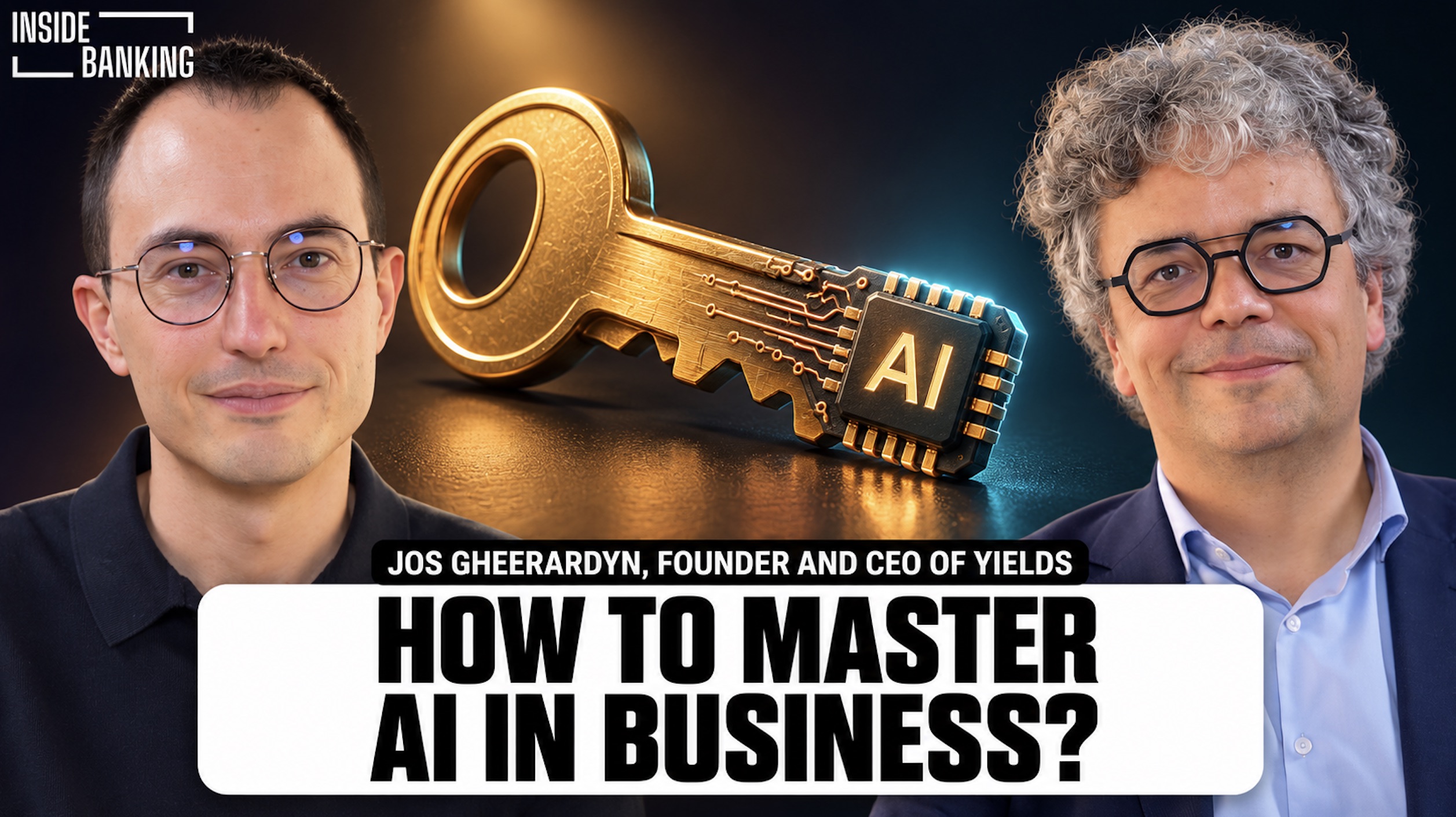
Could banks one day have more AI agents than human employees? In the first English-language episode of Inside Banking, host Richard Michaud welcomes Jos Gheerardyn, co-founder and CEO of Yields.
Together they discuss how financial institutions can deploy hundreds or even thousands of AI agents while keeping the risk under control, and why effective AI governance is becoming essential for banks and businesses alike.
Richard Michaud in conversation with Jos Gheerardyn. Watch the trailer, then the full episode.





Five topics, one question: how do banks embrace AI without losing control?
How autonomous AI systems are changing banking operations, from software development to risk management.
How banks can oversee a growing number of AI systems without multiplying their risk teams.
What the European framework means for financial institutions, from AI inventories to risk classification and compliance.
Who stays responsible when AI agents take over tasks, and how the three lines of defence will evolve.
The biggest challenges ahead and the limits of automation.
Five takeaways from the conversation
When an algorithm replaces the team, AI becomes a board topic
Organisations are building all kinds of new AI systems, and those come with a lot of risk. Jos uses fraud detection as an example. When a human team handled it, one person not doing their job properly was a small amount of risk. That changes once the work is automated.
If you have an algorithm that has replaced the entire team, then suddenly you want to be really sure that the algorithm is working as it should.
According to Jos, two things have shifted at once: market dynamics and competitiveness, and the risk profile of the organisation itself. Balancing the two requires trade-offs, which is why AI has become a board-level topic.
You cannot scale risk management by a factor of 1,000
Everyone can now build AI systems and AI agents, which puts a huge amount of new risk into the market. The volume is the real challenge.
We will create 100 or 1,000 more AI systems, but we are not going to scale the risk management team by a factor of 1,000.
The answer, Jos argues, is more engineering: managing the risk of AI systems and models much more efficiently, with a solution such as Yields. For organisations that want to take the AI revolution seriously, he sees no other way, because the scale of the problem is simply too big.
Hallucinations are a consequence of how LLMs work
Will AI hallucinations ever be fixed? With the current setup of large language models, Jos says, they won’t disappear. A model predicts the most likely next token, and hallucination is a consequence of that. For banks, that makes hallucinations a risk to manage rather than one to wait out.
Not every task needs an AI agent
Jos defines an AI agent as a software system that works in a highly autonomous fashion and needs a large language model for its reasoning. By that definition, there are already plenty of use cases where people use agents but shouldn’t.
A deterministic task, such as looking up an entry in a record or filtering attributes from an object, doesn’t need a stochastic large language model. If you have precise rules, you can implement the rules. That is typically safer than asking a model to spend tokens on it.
Being compliant is not the same as managing risk
The overall purpose of the EU AI Act guidance is to make the use of AI in European society safer. But there is administrative overhead, and with it the risk that an organisation focuses too much on being compliant rather than on mitigating risk. Addressing the rules doesn’t necessarily mean all the risk is properly managed, and Jos stresses the importance of keeping that distinction in mind.
The first step under the AI Act is an overview: an inventory or registry of all your AI systems, which sometimes also needs to be made available to the European Union. And, as Jos admits, most of the time that inventory is still an Excel spreadsheet.
Manage AI and model risk at scale
Yields helps financial institutions keep their AI systems and models under control, from model inventory and validation to monitoring and EU AI Act compliance.
Book a demo
About the
Speaker(s) /
Author(s)

Jos Gheerardyn is the co-founder and Chief Executive Officer (CEO) of Yields. Prior to his current role, he worked as both a manager and an analyst in the field of quantitative finance. With nearly 20 years of experience, he has worked with leading international investment banks and start-up companies. Jos is the author of multiple patents that apply quantitative risk management techniques to the energy balancing market. Jos holds a PhD in superstring theory from the University of Leuven.
Related Articles
Yields recognized twice as category leader in Chartis Research Model Risk & Validation 2024 Report

What is a Model Issue Type?
Effective AI model risk management: from theory to practice