
Model Risk Management for a new generation of analytical and AI driven models
Organisations rely on models for critical decisions across finance, operations, risk and analytics. As models evolve and AI techniques become more common, managing model risk has become more complex.
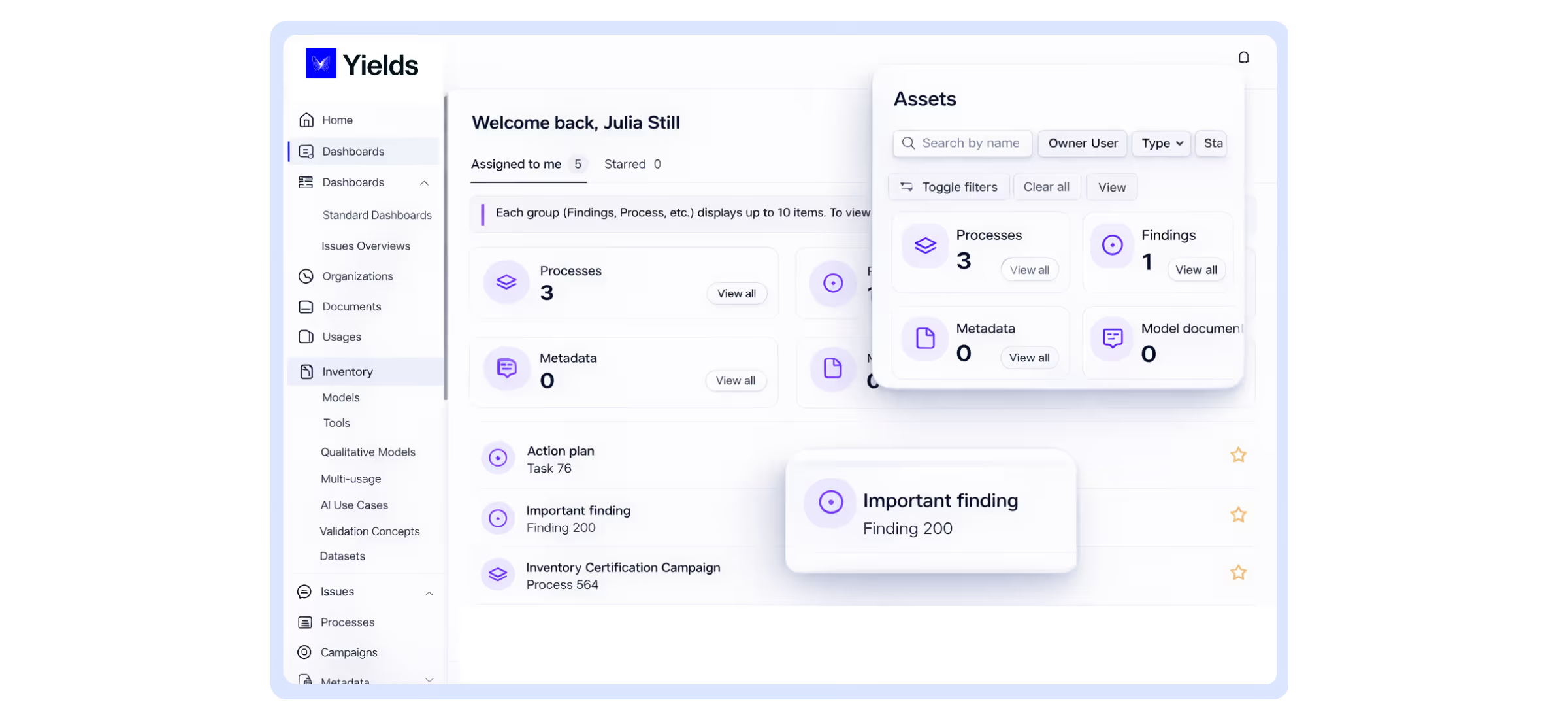
Yields provides a clear and consistent approach to model risk Management so teams can stay in control of their model landscape.
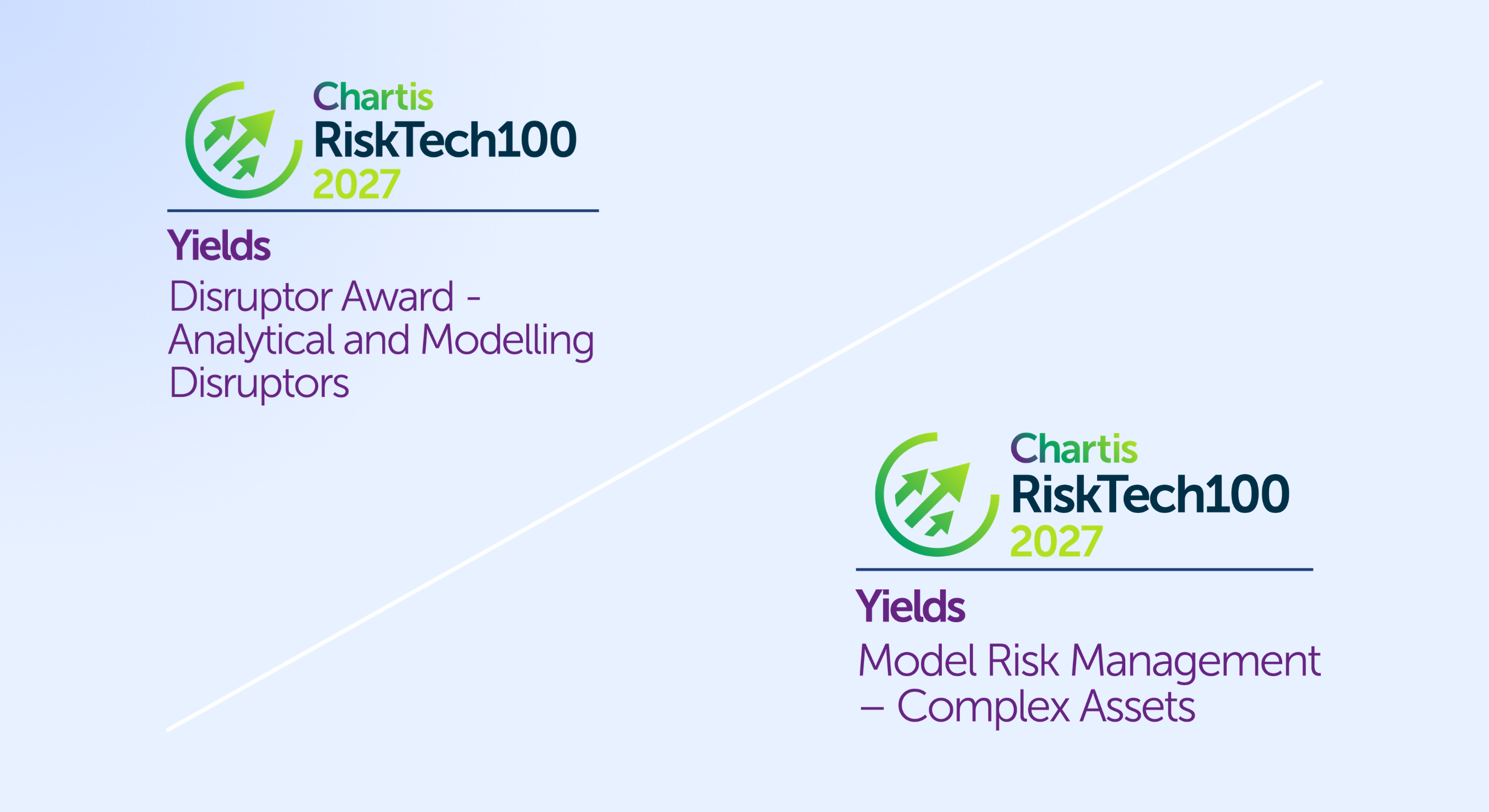

Yields wins twice at Chartis RiskTech100® 2027
Yields has been named Category Winner for Model Risk Management – Complex Assets and listed as one of the Analytical and Modelling Disruptors in the Chartis RiskTech100® 2027.
Recognisable model types across industries
Yields supports a broad range of model types used by both financial institutions and corporates. Yields offers one consistent framework for model risk management across all these model types, regardless of industry or methodology.
Risk & Regulatory models
Finance & Pricing model
Fraud & Transaction Models
Customer, Commercial & Operational models
Machine Learning and AI models

Why is model risk management important?
Model risk teams deal with an expanding landscape of expectations and challenges:


Without structure, model risk increases and oversight becomes harder. Yields supports the full model risk Management process so teams keep control of their model landscape.
A structured model risk management process

Model design and development
Centralized inventory, classification and risk tiers.

(pre)-Validation
Validation workflows and testing results.

Governance & attestation
(Independent) Reviews, approvals and regulatory attestation.

Monitoring
Performance monitoring and model stability.

Change & version management
Controlled model changes, versioning and audit trail.
How model risk management applies to AI
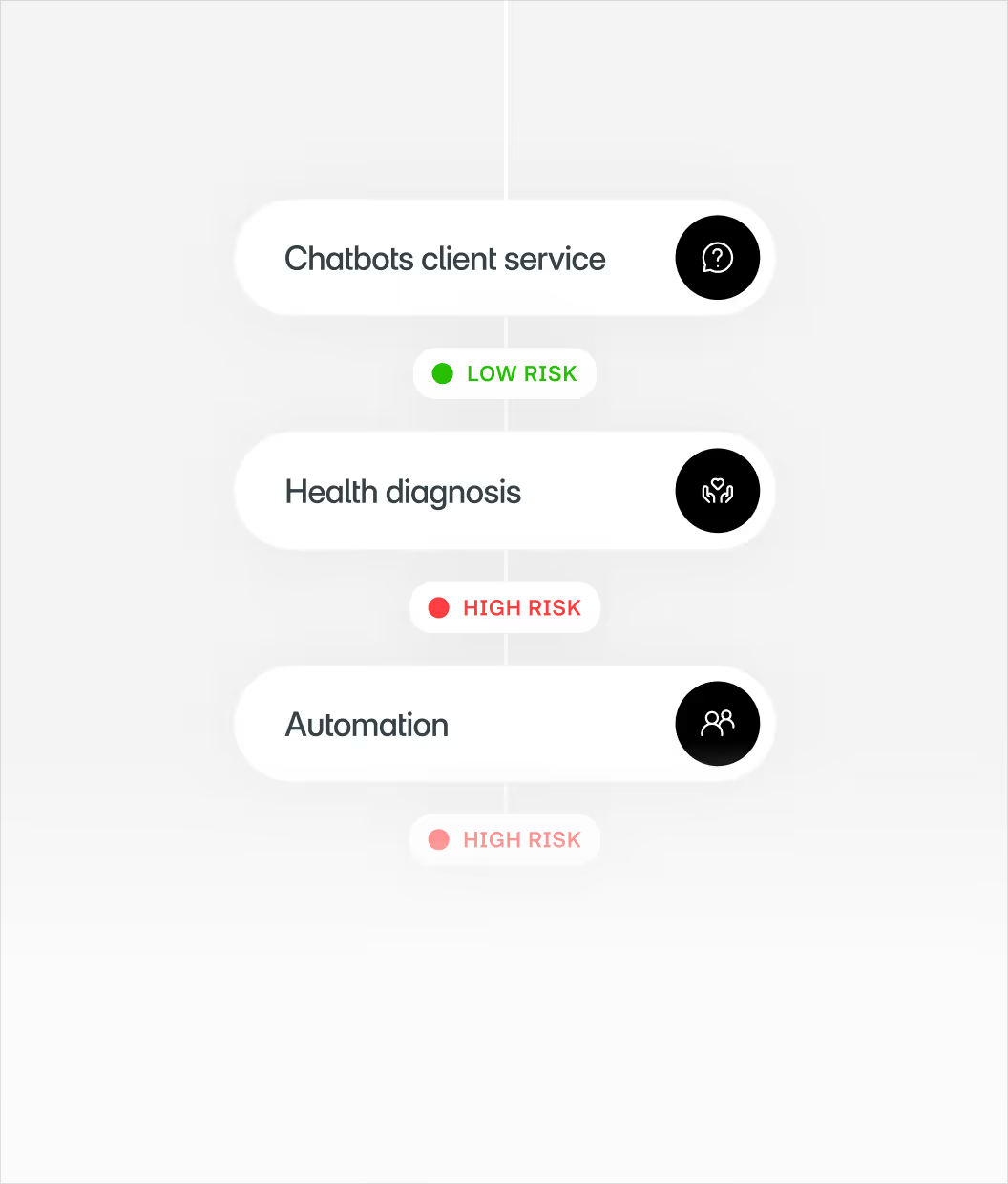
AI use cases often rely on underlying models. Yields connects model risk management with AI governance in a simple way. Validators review the model, while governance teams assess the broader use case and its controls. Both teams work with the same information, which avoids duplication and improves clarity.
The value of using Yields
Strong model risk management leads to better decisions, fewer surprises and smoother supervisory interactions. Organisations using Yields gain clearer oversight, faster validation cycles and more reliable documentation across their entire model landscape.
Reduced validation time
Reduced documentation time
Trusted by leading financial institutions and corporates




Strengthen your Model Risk Management with Yields
Discover how our platform brings structure, transparency and confidence to your model landscape.
FAQ

Model risk management (MRM) is the structured practice that organisations use to govern, assess, monitor and control the risks from models and analytics used in decision making. It ensures models are documented, reviewed, tested and aligned with risk policies and regulatory expectations. Yields offers a technology platform to bring structure and oversight across the full model landscape so teams can maintain control of their models and related risk.
MRM aims to:
- reduce errors in models
- document model purpose and use
- support oversight and audit readiness
- ensure consistent outcomes from model decisions
The model lifecycle generally consists of the following phases:
Model Proposal – Define the business need and perform an initial risk assessment.
Model Development – Build the model, select methodology and prepare data.
Pre-Validation – First-line testing and documentation review.
Independent Review – Second-line validation and formal assessment.
Approval – Formal sign-off by relevant stakeholders.
Implementation – Controlled deployment into production.
Validation & Monitoring – Ongoing performance validation and continuous monitoring in production.
Each phase includes clear responsibilities, controls and documentation requirements.
Effective model lifecycle governance ensures models remain accurate, relevant and safe for use at every stage. Yields’ software centralises these lifecycle stages to make them easier to manage.
Model risk is the potential for negative outcomes if a model produces inaccurate, biased or inappropriate results that lead to poor decisions or regulatory breaches. It arises when models are flawed, misused, or fail to reflect the real world. Model risk can result from issues such as:incomplete or biased input datawrong assumptions in designerrors in implementationIt can affect financial performance, strategic decisions and compliance.
Model validation is the process used to independently test and assess a model’s performance, reliability and appropriateness before use and during its life. Key validation activities include:
- Performance testing to check accuracy and stability
- Sensitivity analysis to explore output response to input changes
- Benchmarking against alternative models or outcomes
- Documentation review for methodology and assumptions
- Independent review by a validation team separate from the developers
A strong validation process is central to managing model risk and building stakeholder confidence.
A robust MRM framework typically includes:
- Governance and policy that sets roles, responsibilities and risk appetite
- Model inventory with classification and status of all models
- Risk assessment to measure potential impacts and prioritise efforts
- Validation and testing protocols tied to risk level
- Monitoring and maintenance to track performance over time
- Documentation and audit trails for transparency and compliance
These components ensure that models are understood, controlled and aligned with organisational objectives.
Organisations draw on established frameworks and standards to guide MRM. Common references include:
Regulatory guidelines such as those issued by prudential regulators for banks and insurers
Enterprise risk management structures that integrate model risk with other risk types
Internal control standards that define roles, approval authorities and audit requirements
These frameworks emphasise consistent governance across the lifecycle and risk-based oversight.
Tools that support MRM help teams manage inventory, enforce workflows, track documentation and automate tests. Examples of capabilities include:
- centralised model inventory and classification
- workflow engines for validation and approval tracking
- performance and stability monitoring
- version control and audit logs
The Yields Model Risk Management Suite provides software to support all these capabilities and brings structure to the lifecycle.
Model risk management for AI and machine learning applies the same principles to more complex models:
- AI models often involve high dimensional data and non-linear relationships
- they can be less transparent and harder to explain
- the pace of change and retraining increases oversight needs
MRM for AI includes structured validation of training data, monitoring for drift after deployment and governance that ties model risk to organisational policy. This makes oversight consistent and reduces risks from incorrect or biased AI outputs. Yields connects MRM with AI governance so validators and governance teams work with the same information, which avoids duplication and improves clarity.