Governing AI agents at scale: key takeaways from Yields at RiskMinds 2026
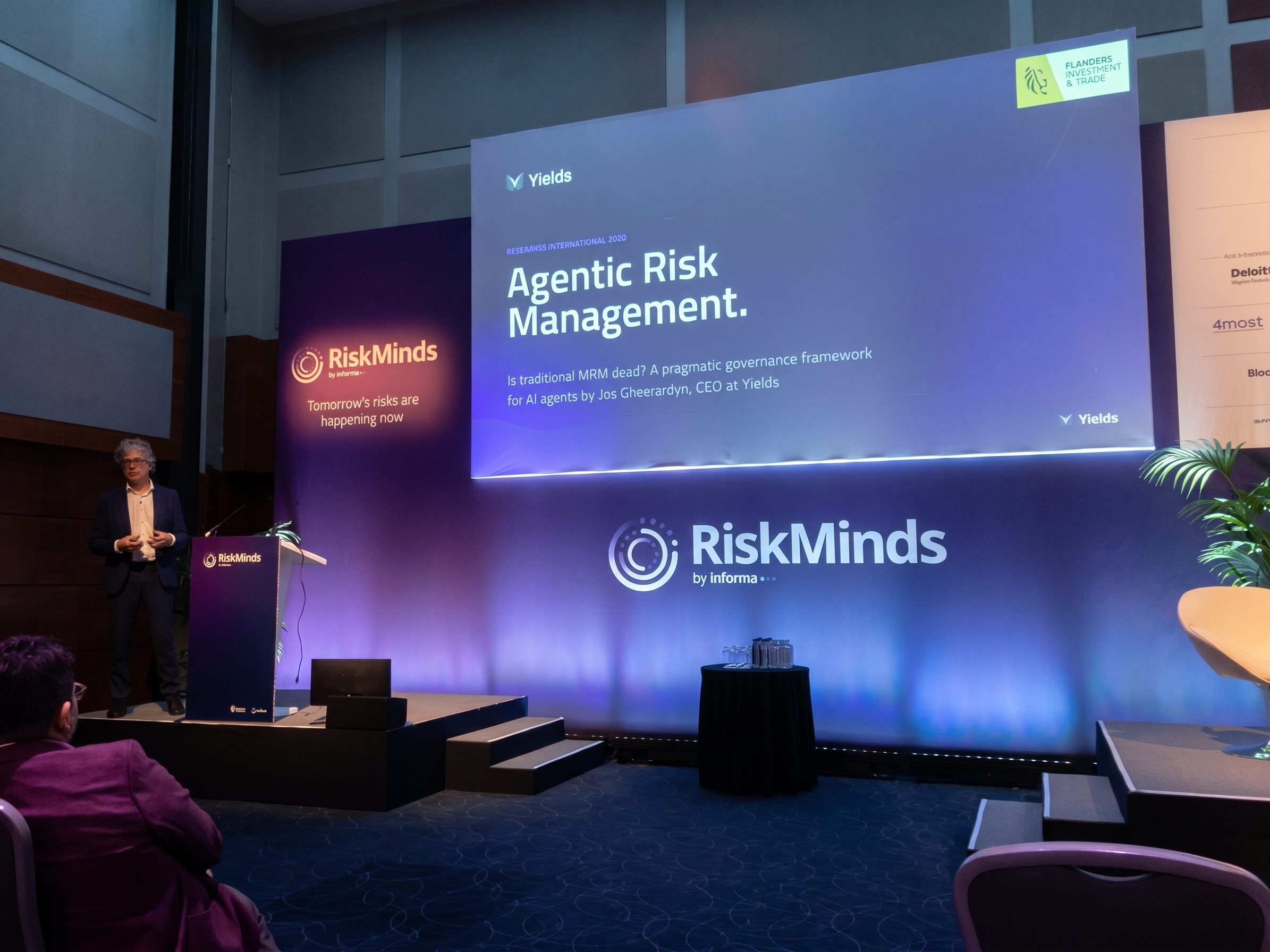
At RiskMinds International 2026, Jos Gheerardyn, CEO of Yields, asked a question many risk teams are quietly asking themselves: now that AI agents are entering the bank, is traditional model risk management dead? His answer is no. But it has to change. Here are the key ideas from the talk, and the slides to download.answer it, and this is where your choice of software vendor matters too, not just your infrastructure. Where your vendor is based, and how much say you have over that relationship, shapes how much you can honestly promise your own regulator.
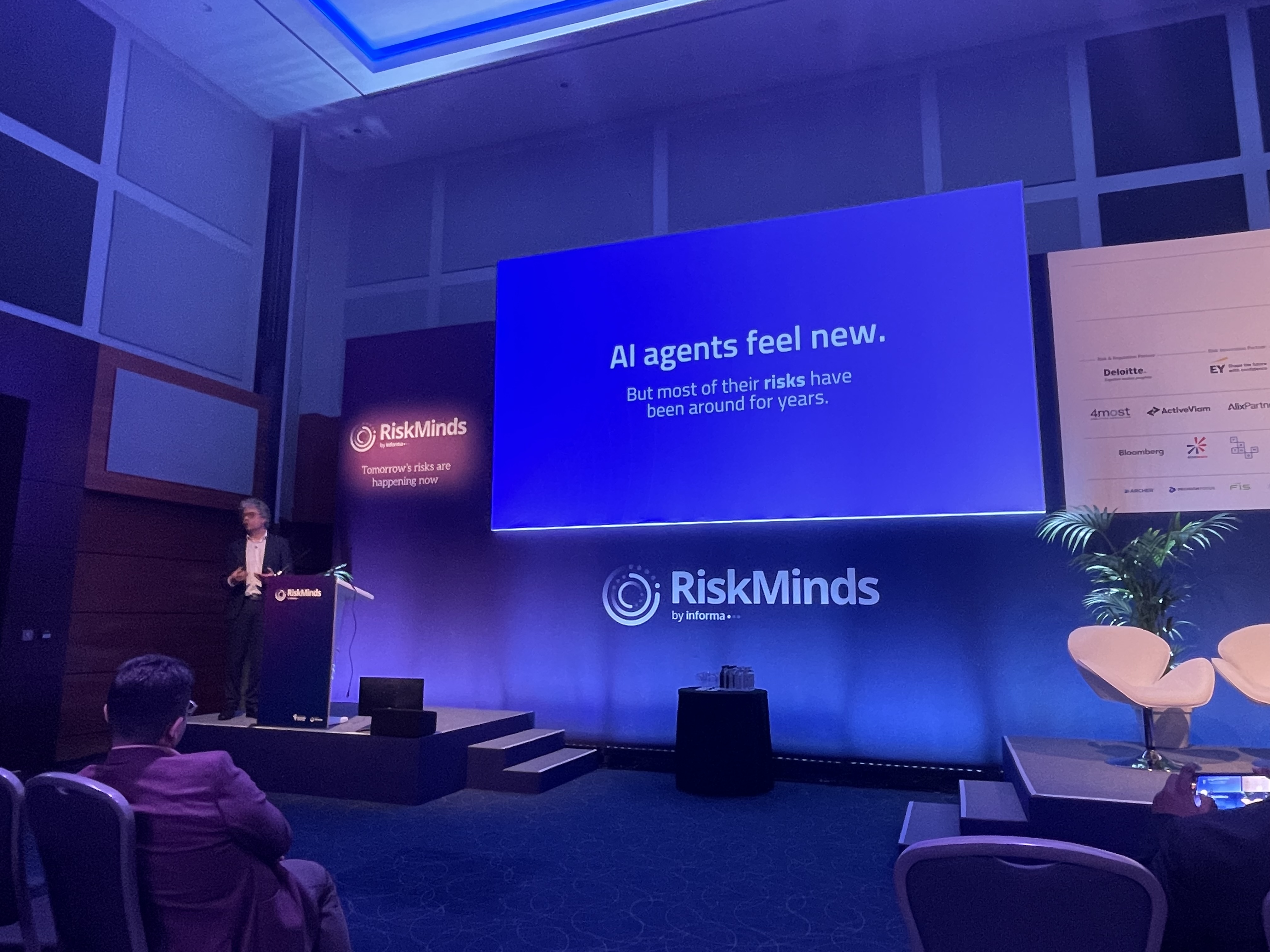
AI agents feel new. Most of their risks are not.
AI agents act autonomously, behave differently from one run to the next and can wander outside the task they were built for. That sounds like a brand-new risk category. It is not. Banks have faced each of these risks before.
- Autonomy. In 2012, Knight Capital lost $440 million in 45 minutes because of a faulty trading algorithm. Algorithmic trading is autonomous, hard to backtest and constantly updated. So are agents.
- Use beyond scope. In the 2008 crisis, banks wrote down $218 billion on ABS CDOs, partly because models were used far beyond what they were built for. Agents drifting outside their scope is the same risk.
- Non-determinism. Monte Carlo pricing models are non-deterministic by design, and their sensitivities are hard to stabilise. Agent outputs are non-deterministic too.
The good news: we already know how to govern these risks. Algorithmic trading taught us real-time, preventative controls. Generic derivative pricers taught us to approve and restrict scope and usage per model. Monte Carlo models taught us to control convergence and sampling. The same principles apply to agents.
The new challenge is scale
What is new is volume. Gartner expects the average global Fortune 500 enterprise to have over 150,000 agents in use by 2028, up from fewer than 15 in 2025 (Gartner press release, 28 April 2026).
Three things make manual governance break at that scale:
- Built in minutes. Anyone, including non-technical staff, can build and deploy a capable agent.
- No central control. Agents, including vendor agents, appear all over the organisation.
- Endless paths. Upfront validation can never cover every possible multi-step path an agent can take.
So the real question is simple. Your agents grow 10,000 times. Does your risk team? It will not. That is why scale needs engineering, not just more reviewers.
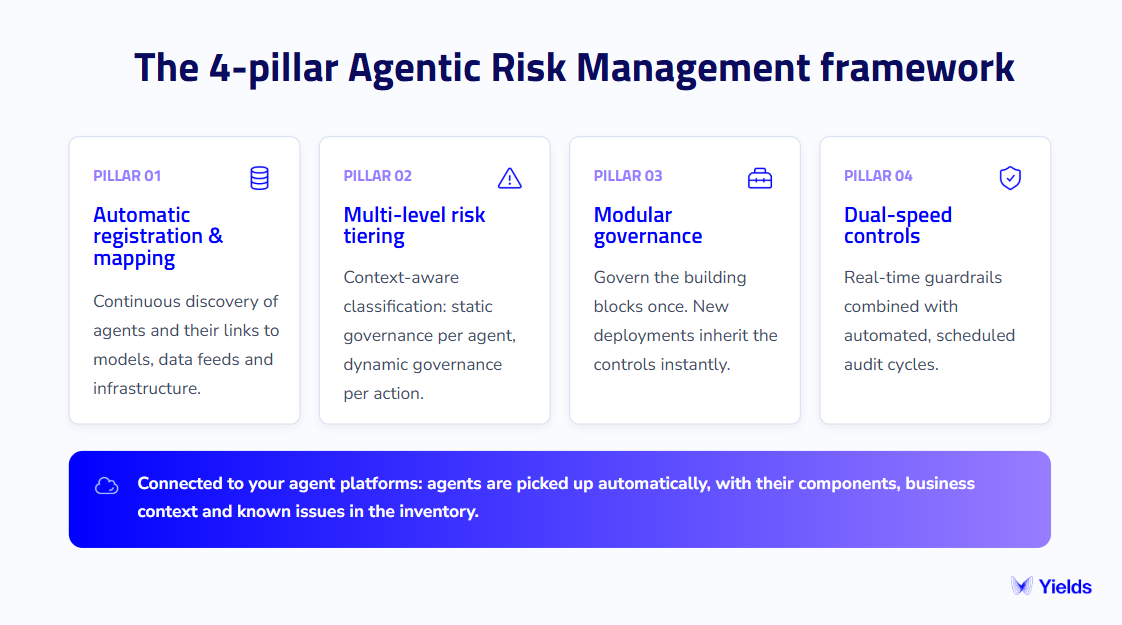
A four-pillar framework for agentic risk management
Jos presented a pragmatic framework that combines classic governance principles with engineering. Each pillar answers one part of the scale problem.
Pillar 1. Automatic registration and mapping
You cannot govern what you cannot see. Every agent needs a standard description, an agent passport, so any platform can register it automatically. The passport builds on standards that already exist: A2A Agent Cards for identity and scope, MCP and OpenAPI for tools, OAuth 2.0 and SPIFFE for access, and ISO/IEC 42001 for safety and governance.
Agents are registered when they are built, check in before every run and have every dependency mapped. When a prompt or model changes, every agent that depends on it is flagged for review.
Why it matters: at an Ontario hospital, a former doctor's personal AI notetaker joined a meeting and shared patient information with 65 people. Nobody had approved the bot. The lesson: if it is not in the inventory, it does not get in.
Pillar 2. Multi-level risk tiering
Agents need two risk dimensions.
- Static, per agent, before launch. Set at registration based on capabilities, data access and audience. It decides how deeply and how often an agent is reviewed. A drafting agent for internal notes is low risk. The same agent answering customer complaints is high risk.
- Dynamic, per action, during run time. A control plane classifies every action as it happens. Reading a public database runs. Writing to a ledger or emailing a customer is intercepted.
Two incidents show why both are needed. In 2024, Air Canada had to honour a refund policy its customer chatbot invented. Who an agent talks to should set its static tier. In 2025, a coding agent on Replit deleted records of more than 1,200 executives from a live database during a code freeze, with no human check. A delete on production is a high-risk action and should be stopped before it runs.
The control plane runs in the first line. The second line needs full transparency into its settings and logs.
Pillar 3. Modular governance
Thousands of agents are built from a small number of building blocks: guardrails, skills, tools, LLMs, vector databases and API gateways. Govern the platform centrally, govern each building block once, and give individual agents a light-touch approval.
Take a RAG chunking algorithm. Review and approve it once, and its compliance status propagates automatically to every agent that uses it. New deployments inherit the controls instantly.
Pillar 4. Dual-speed controls
Governance has to work at two speeds.
- Real-time guardrails check every call in milliseconds and block or redact what falls outside the rules.
- Offline reviews run on a schedule set by the static tier. They sample past reasoning for drift and audit the guardrail settings. A critical finding stops the agent.
The two loops feed each other. Think of a region of validity. Calls inside the validated region run. Calls outside are blocked in real time. If offline review shows that one legitimate use case keeps getting blocked, governance can safely widen the region. Control and usability improve together.
Two things to take home
- Familiar risks. Unprecedented scale. The principles of model risk management still hold. Manual controls simply cannot keep up with the speed and volume of agents.
- Governance plus engineering equals agentic risk management. Governance sets policy, tiers and scope. Engineering enforces them in real time.
So no, traditional MRM is not dead. It is the foundation agentic risk management is built on.
How Yields supports agentic risk management today
Yields helps risk teams put the four pillars into practice on one platform:
- Multi-inventory and dependency mapping. Connected inventories for agents, capabilities, skills and tools, kept current via API and CI/CD.
- Static tiering and control-plane transparency. Tiering in the inventory, with runtime control-plane settings visible to the second line.
- Inherited compliance. A shared component is reviewed once, and its status propagates to every dependent agent.
- Telemetry-aware reviews. Validators query and sample trajectory logs during reviews, and a Stability Score flags issues early.
Download the slides
Want the full framework, examples and visuals from the talk? Download Jos Gheerardyn's RiskMinds 2026 presentation.
About the
Speaker(s) /
Author(s)

Jos Gheerardyn is the co-founder and Chief Executive Officer (CEO) of Yields. Prior to his current role, he worked as both a manager and an analyst in the field of quantitative finance. With nearly 20 years of experience, he has worked with leading international investment banks and start-up companies. Jos is the author of multiple patents that apply quantitative risk management techniques to the energy balancing market. Jos holds a PhD in superstring theory from the University of Leuven.


Related Articles
What is Model Validation?

Bridging Data Governance and Model Risk Management
What is Model Risk Management? The basics