
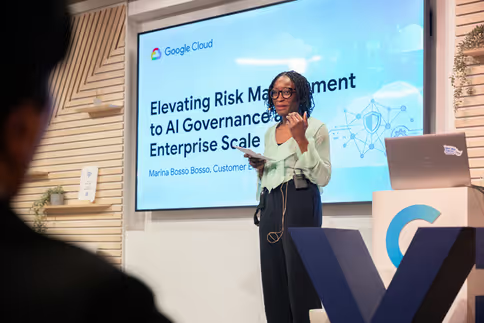
Elevating Risk Management to AI Governance at Enterprise Scale

At Yields Innovate on March 12, Marina Bosso Bosso, Customer Engineer at Google, delivered a compelling presentation on the urgent need to evolve traditional risk management into comprehensive AI governance. As businesses rapidly integrate Generative AI across their operations, the old methodologies for managing model risk are no longer sufficient.
Here are the key insights from her talk on how enterprises can build trust, ensure compliance, and safely accelerate their AI adoption.
The Paradigm Shift: From Deterministic to Stochastic Models
For years, organizations operated in a world of predictive models designed to answer specific questions, such as whether a loan would default or if a transaction was fraudulent. In that era, model risk management (MRM) was a gatekeeper—a static checklist to ensure a model functioned as expected before it went live. Bosso Bosso compares this traditional MRM to the mechanical inspection of a car's engine to ensure it won't stall.
These traditional models were deterministic: providing input 'A' would always yield output 'B'. Generative AI, however, is stochastic by nature. Providing the exact same input twice can result in completely different answers.
Because of this fundamental shift, organizations can no longer rely on static or semi-static assessments. We are no longer simply managing a fixed algorithm; we are governing dynamic intelligence that creates content, writes code, and generates images.
AI Governance: The Brakes That Make You Go Faster
A common misconception is that AI governance is a "no" function designed to slow things down. Bosso Bosso challenges this narrative, arguing that trust is the only way to scale innovation.
She illustrates this with a powerful analogy: "Without brakes, a car can only go so fast. With elite brakes, it can go 200 mph". AI governance goes beyond the basic mechanical inspection; it provides the traffic laws, driver's licenses, and insurance that ensure the vehicle is used safely on the open road. By transforming black-box algorithms into high-trust assets, businesses remove the hesitation that typically stifles innovation.
A Cross-Functional Imperative
AI is not simply a data science problem. Generative AI has permeated every department, becoming the connective tissue of the modern enterprise. As the technology spreads, the risk surface explodes.
Bosso Bosso highlighted several departmental risks that require centralized governance:
- Finance: If an AI customer service agent hallucinates and promises a user a 0% interest rate, it is not just a technical glitch; it creates significant legal and reputational risk.
- Human Resources: When using AI to screen resumes or analyze interview sentiment, the system can inadvertently bake in historical biases.
- IT & Operations: With a massive portion of modern code being AI-generated, there is a risk of automating the creation of security vulnerabilities or utilizing unlicensed libraries.
The Pillars of Responsible AI
To navigate these risks, Google utilizes a "Responsible AI" framework built on four non-negotiable pillars to ensure systems are responsible by design:
- Fairness: Ensuring training data is fully representative of all subgroups so the AI treats everyone equally.
- Accountability: Taking ownership of the AI system's actions through transparency, interpretability, and explainability.
- Safety and Security: Implementing controls to prevent known AI risks like data poisoning and prompt injection.
- Privacy: Abiding by regulatory requirements (like GDPR) while protecting sensitive data encountered during training phases.
Automating Governance for Scale
How does an enterprise govern thousands of models at the speed of innovation? Relying solely on manual reviews and physical committees is impossible. Governance must become an automated, invisible part of the pipeline.
This is achieved through:
- Automated Policy Enforcement: Turning company values and policies into code, establishing guardrails that halt a model from reaching production if it exceeds predefined bias thresholds.
- Continuous Monitoring: Governance does not stop at deployment; tools must continuously track behavioral drift and safety issues in real-time.
- Golden Thread of Metadata: Maintaining a single source of truth that tracks an asset from its training stage all the way to the API call, making audits seamless.
The Monday Morning Plan
To help organizations transition from shadow AI to a governed enterprise portfolio, Bosso Bosso closed with a three-step action plan for immediate implementation:
- Inventory: Build a comprehensive registry of all current AI use cases and models.
- Policy: Translate organizational values into specific guardrails and actionable KPIs.
- Automation: Transition from manual project oversight to automated platform enforcement.
About the
Speaker(s) /
Author(s)


Related Articles
Making your Model Inventory work for your organization: An Overview

Managing AI Risk in Practice
Governance, Risk Management, and Compliance for Banking Institutions