
The Model Risk of Climate Risk Models
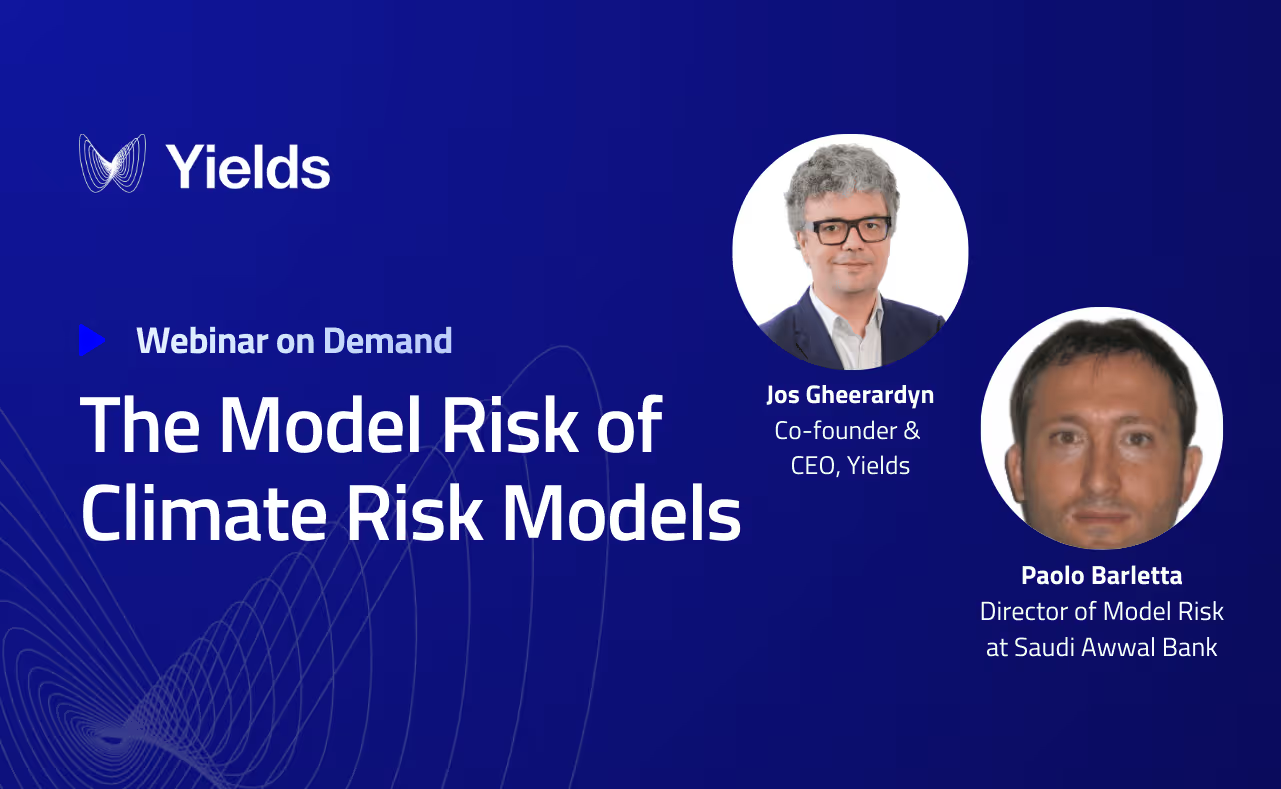
In this webinar, Paolo and Jos will discuss the challenges financial institutions face in incorporating climate risk models. They will cover building a portfolio of models to estimate climate impact, conducting climate stress tests, and assessing third-party model risk for climate models.
Joining our CEO, Jos, is Paolo Barletta. Paolo holds a PhD in theoretical physics from University College London and has over a decade of experience in third- and second-line defense roles in model risk management. He currently serves as the Director of Model Risk at Saudi Awwal Bank.
About the webinar
As climate change reshapes risk profiles across the financial industry, banks are under growing pressure to understand, and manage, the models used to quantify climate impact. But these models, often complex, multi-layered, and externally sourced, carry their own risks. How can financial institutions govern them effectively?
In our recent webinar, Yields CEO Jos Gheerardyn spoke with Paolo Barletta, Director of Model Risk at Saudi Awwal Bank, about this very question. With a PhD in theoretical physics and over a decade in model risk leadership, Paolo offered both scientific depth and practical insight into one of the most dynamic areas of model governance today.
Climate models: a layered architecture
Climate risk cannot be captured through a single model. Instead, institutions work with a portfolio of interconnected models, often sourced from third parties and spanning a wide range of scientific disciplines. These include physical climate models, transition risk assessments, and macroeconomic simulations. Managing this complexity poses challenges in validation, explainability, and model integration, especially when components of the model chain are developed by external parties.
Stress testing redefined: from scenarios to pathways
Unlike traditional stress tests, which are often short-term and based on discrete events, climate stress testing works with long-term "pathways", forward-looking trajectories that combine environmental, regulatory, and socio-economic factors. These require institutions to model both global climate patterns and highly localized risks, such as flooding or heat exposure. Effective governance depends on understanding not only what the model says, but how sensitive it is to different assumptions and inputs.
Third-party models and recursive risk
Most climate models used by financial institutions are sourced externally. However, as Paolo noted, these third-party models are often built on other external components, forming a chain of fourth- and fifth-party dependencies. This recursive model structure introduces governance challenges: how can institutions verify the integrity of a model if its inner workings are opaque or outsourced several layers deep?
Monitoring and validation challenges
Backtesting climate models is rarely feasible due to the long time horizons involved. Instead, institutions must focus on comparing model outputs, assessing scenario sensitivity, and monitoring the assumptions and input data used. Many key data points, such as physical asset locations or emissions linked to financed activities, are often incomplete or unavailable, adding further complexity to the validation process.
Looking ahead
The discussion concluded with a recognition that climate model risk management is still in its early stages. Key challenges include integrating climate models into existing model risk frameworks, improving data availability and quality, and developing the internal skill sets needed to engage with these models critically. As Paolo emphasized, while banks may not build their own climate models, they do need to understand them, and govern them, with the same level of scrutiny applied to any other high-impact model.
As regulatory expectations grow and climate disclosures become mandatory, effective oversight of climate risk models will be essential to building trust and resilience across the financial system.
About the
Speaker(s) /

Jos Gheerardyn is the co-founder and Chief Executive Officer (CEO) of Yields. Prior to his current role, he worked as both a manager and an analyst in the field of quantitative finance. With nearly 20 years of experience, he has worked with leading international investment banks and start-up companies. Jos is the author of multiple patents that apply quantitative risk management techniques to the energy balancing market. Jos holds a PhD in superstring theory from the University of Leuven.

Related Articles
Bridging Data Governance and Model Risk Management

Navigating UK Banking Regulations
Round Table - Is traditional MRM dead?