
Navigating SR 26-2: 7 Key Shift in MRM
The Model Risk Management regulatory landscape is shifting. With US regulators (the Federal Reserve, OCC, and FDIC) issuing SR 26-2, "Supervisory Guidance on Model Risk Management," we are seeing a significant evolution from the long-standing SR 11-7. While the foundational pillars of model risk management (MRM) remain, the updated guidance reflects just how complex and fast-paced our modern financial world has become, especially with the rise of sophisticated algorithms and rapid technological change.
If you are currently navigating this transition, we can imagine that this raises a lot of questions for your organization, particularly regarding your tech stack. This shift moves us away from static compliance checklists and toward a world of dynamic, interconnected orchestration. In this article, we’ll dive into how SR 26-2 is reshaping MRM technology requirements and how platforms like Yields can help you meet these new mandates.
1. Beyond Rigid Frameworks: The Mandate for Extreme Configurability
The guidance explicitly states that MRM practices vary across organizations and must be tailored to an institution’s specific nature, scale, and risk profile. There are no "enforceable standards" or prescriptive requirements; instead, the responsibility lies with the organization to adopt effective practices.
- Technological Impact: Legacy systems with "hard-coded" elements such as workflows, business logic or risk tiering are now a liability. Technology must be extremely configurable, allowing banks to operationalize their unique internal policies rather than forcing them into a vendor’s rigid mold.
- Solution Approach: To achieve this flexibility, platforms must be built as highly configurable orchestration engines. This allows institutions to centralize industry best practices while maintaining the ability to tailor business logic, workflows, and risk tiering to their unique internal policies, ensuring the platform can evolve as the risk profile changes.
2. Managing Aggregate Risk via Dependency Graphs
SR 26-2 places a clear emphasis on assessing model risk not just individually, but in aggregate. Think of model risk as a puzzle. We can't just look at the individual pieces. We need to see the aggregate picture. This means understanding how models lean on each other and share the same data, because if one fails, the whole chain could come crashing down.
- Technological Impact: A flat inventory (e.g., an Excel spreadsheet) cannot fulfill this requirement. Organizations require a dependency graph. This is a relational model inventory that maps the "lineage" of risk across the enterprise.
- Solution Approach: A robust solution requires treating the model inventory not as a flat list, but as a web of interconnected, relational objects. This dependency mapping enables users to trace the lineage of risk across the enterprise, quickly identifying systemic vulnerabilities where a shared data source or assumption could impact multiple downstream models.
3. The Model Inventory as a Knowledge Base, Not a Compliance Tool
The guidance highlights that model users must understand a model’s limitations and provide feedback to improve development. Engagement between developers, users, and business managers is seen as a way to strengthen model quality and understanding.
- Technological Impact: The MRM platform must serve as a centralized knowledge base accessible to all stakeholders, not just a gated system for validators or compliance officers. It should facilitate "constructive engagement" and lifecycle-long communication.
- Solution Approach: The technological platform should function as a centralized knowledge base accessible to all stakeholders. By facilitating 'constructive engagement,' the system can ensure that insights and limitations raised during development are seamlessly funneled into ongoing monitoring plans and user-facing dashboards, strengthening the overall quality and understanding of the model.
Points 2 & 3 can be summarized by the requirement that a model inventory should be a knowledge graph.
4. Addressing the "Shadow AI" Perimeter
A notable complexity in SR 26-2 is the exclusion of Generative AI and agentic AI from the specific scope of this document. However, the guidance clarifies that banks must still determine appropriate governance and controls for tools not covered here. Furthermore, traditional models that feed into or receive inputs from GenAI systems remain firmly in scope.
- Technological Impact: To avoid "governance gaps," an inventory must be comprehensive enough to include these novel AI systems, even if they follow a different validation path.
- Solution Approach: To prevent 'governance gaps,' technology must support a multi-governance mode. This involves maintaining a comprehensive inventory that can accommodate different validation paths for novel AI systems (like GenAI), while still allowing different governance teams (e.g., MRM and AI/Data Science) to browse and share related objects for a unified view of the risk perimeter.
5. Flexibility for Urgent Business Realities
The regulator acknowledges that "urgent business needs" may sometimes require using a model prior to the completion of formal validation. In such cases, the guidance mandates increased attention to limitations and the implementation of temporary controls.
- Technological Impact: The system must be pragmatic, supporting "exception-based" workflows that allow for pre-validation use while enforcing strict monitoring and stakeholder notification.
- Solution Approach:. Exception-based workflows allow for necessary pre-validation use in urgent situations while automatically enforcing strict monitoring, stakeholder notification, and automated tracking of exceptions to prevent 'temporary' use from becoming permanent without proper oversight.
6. From Structural Independence to "Effective Challenge"
While SR 11-7 emphasized organizational independence, SR 26-2 focuses on the quality and impact of the challenge itself. It mandates that those conducting the challenge must have the "organizational standing and influence to effect any change".
- Technological Requirement: The system cannot just be a document repository; it must be a workflow engine that tracks the dialogue of the challenge. In addition, it means that the platform should be flexible enough to deal with a variety of setups that implement this effective challenge.
- Solution Approach: To support the required dialogue and flexibility, the system must function as a robust workflow engine, not merely a document repository. It should track the entire 'challenge' dialogue, creating a transparent, non-erasable audit trail of queries raised by validators and the subsequent remediations by developers, regardless of the organizational structure.
7. The Proprietary "Black Box" Strategy (Vendor Risk)
The guidance explicitly addresses the "unique challenges" of vendor models where underlying code or data may be proprietary. It shifts the focus from code review to ongoing outcomes analysis and monitoring to ensure the model remains "fit for purpose".
- Technological Requirement: Tech must support black-box testing capabilities, such as benchmarking vendor outputs against internal "challenger" models or real-world data without needing the vendor’s source code.
- Solution Approach: Technology must provide specialized support for black-box testing. This capability enables automated outcomes analysis and standardized quantitative tests against vendor model outputs, allowing organizations to benchmark performance and detect deterioration by comparing results against internal 'challenger' models or real-world data.
How Yields supports the transition to SR 26-2
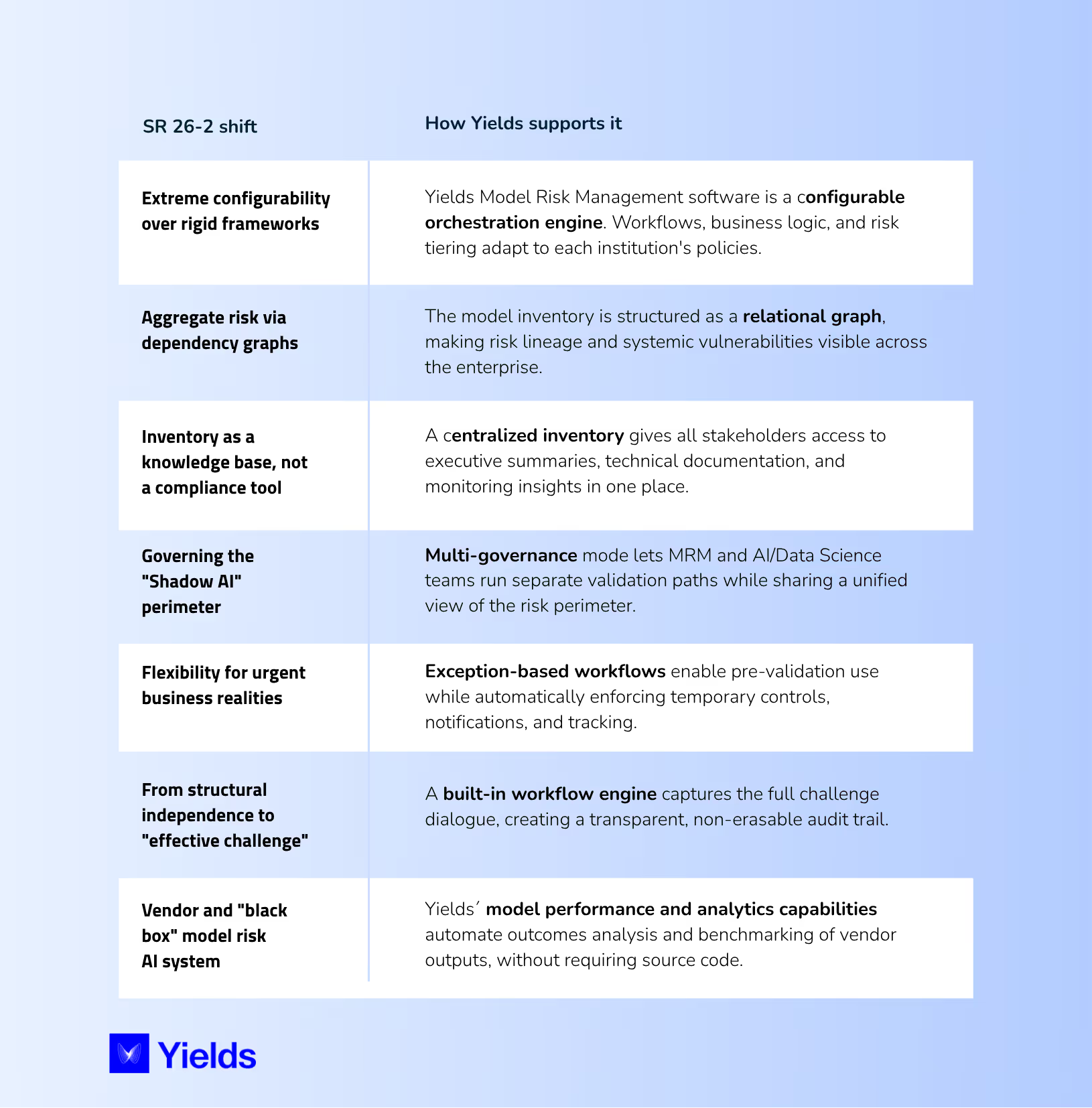
Meeting these new expectations requires more than a document repository or a static inventory. It requires a platform built around flexibility, interconnectivity, and auditability. Yields is designed as a configurable orchestration engine, allowing institutions to operationalize their own policies, map dependencies across their model landscape, and maintain a transparent audit trail throughout the model lifecycle. Whether you are a Tier 1 bank with a mature MRM framework or a smaller institution scaling up your governance, Yields is built to evolve alongside your risk profile. The table below summarizes how Yields supports each of the shifts introduced by SR 26-2.
Conclusion: From Compliance to Performance
SR 26-2 reinforces that model risk management is not a technical exercise. It is a multidisciplinary effort that requires sound judgment and robust technology. As technology becomes the backbone of MRM, the focus must shift from merely "checking the box" to using these systems to drive innovation and better mitigate risk. For organizations seeking a solution, configurable platforms are essential. A platform that acts as a flexible orchestration engine, like Yields, is designed to operationalize unique internal policies, ensuring that your MRM framework can evolve seamlessly with your organization's risk profile.
About the
Author(s)

Jos Gheerardyn is the co-founder and Chief Executive Officer (CEO) of Yields. Prior to his current role, he worked as both a manager and an analyst in the field of quantitative finance. With nearly 20 years of experience, he has worked with leading international investment banks and start-up companies. Jos is the author of multiple patents that apply quantitative risk management techniques to the energy balancing market. Jos holds a PhD in superstring theory from the University of Leuven.
Related Articles
Build vs. Buy in Model Risk Management

What is model inventory rationalization?
What is Model Input?