
From Principles to Practice: Building Strong AI Governance

Watch the full keynote at the bottom of this article.
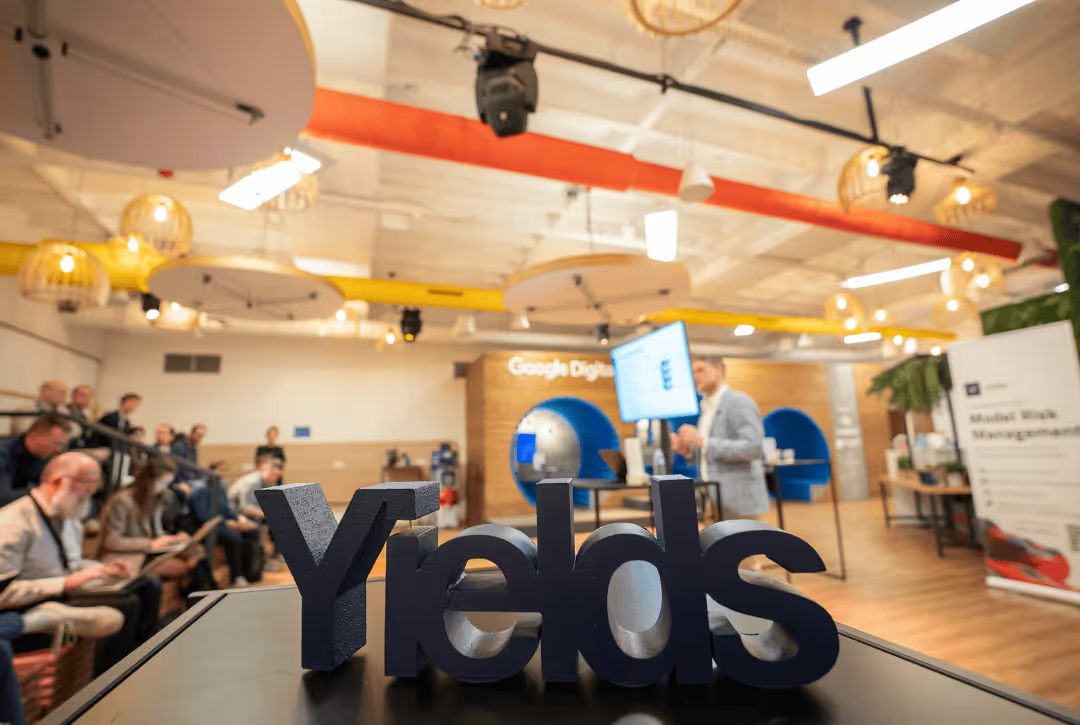
On March 12, the annual Yields Innovate event featured a comprehensive keynote by Jelle Hoedemaekers, an expert in the data economy working for the Belgian technology industry federation, Agoria. His presentation, titled "From Principles to Practice: Building Strong AI Governance for Today and Tomorrow," provided critical insights into the evolving landscape of AI regulations, the complexities of compliance, and the role of international standards.
The Real Reason We Need AI Governance
While the impending regulatory landscape is a massive driver for AI governance, Hoedemaekers highlighted a more immediate business concern: AI projects are failing. Companies feel pressured to adopt AI quickly so they aren't left behind, leading to a rush of pilots and proof-of-concepts. However, without proper governance, these initiatives often fail to create real value when put into practice. Governance provides the necessary framework to not only mitigate new organizational risks but also to ensure AI projects actually succeed.
Navigating the EU AI Act
A core part of the presentation focused on demystifying the EU AI Act. Hoedemaekers emphasized that the AI Act is fundamentally a piece of product legislation.
To understand how it will be enforced, organizations need to understand the "New Legislative Framework" (NLF). Under the NLF:
- The overarching regulation outlines the high-level, essential requirements.
- The specific technical details and specifications are extracted from the law and detailed in supporting standards.
- By implementing these specific standards, organizations gain a "presumption of conformity," allowing them to legally place their products on the market.
- Providers of high-risk AI systems must perform individual conformity assessments for each system before bringing it to market.
The Role of Standards: A Crucial Distinction
A significant portion of the keynote clarified the relationship between international standards and European compliance. While international standards are currently being developed, they are not a silver bullet for the EU AI Act.
Here is what organizations need to know about the current standards ecosystem:
- ISO/IEC 42001 (AI Management System): This standard serves as a highly beneficial foundational step for organizations to structure their AI governance, defining risk criteria, policies, and roles.
- The Compliance Myth: Hoedemaekers explicitly warned that achieving ISO 42001 certification does not grant compliance with the EU AI Act.
- European Standards: The European Commission has mandated the creation of specific standards tailored to support the AI Act.
- Areas of Focus: These upcoming European standards will cover critical areas such as risk management, data quality, logging, transparency, human oversight, and cybersecurity.

Complexities and the Road Ahead
The transition toward full compliance is riddled with challenges, especially for smaller businesses. Many of the SMEs driving AI innovation lack experience with implementing complex, heavy standards. Consequently, there is a risk that market access will become much harder for SMEs, as deployers will likely demand fully certified partners.
Looking toward the future, Hoedemaekers shared several regulatory outlooks:
- "Stop-the-Clock": Because the necessary European standards are not yet ready, discussions surrounding the "Digital Omnibus" are pushing for an 18-month delay on the initial compliance deadlines.
- Simplification for Smaller Entities: There is a push to extend simplified Quality Management System (QMS) requirements to both SMEs and Small Mid-Caps (SMCs) to reduce their administrative burden.
- Belgian Market Surveillance: At the national level, Belgium is actively structuring its market surveillance authority architecture, which will likely involve different regulators, such as the BIPT and FSMA, taking responsibility for different segments of the AI Act.
Conclusion: Embracing the Governance Journey
As AI continues to transform industries, the transition from high-level principles to concrete, day-to-day practice is no longer optional. Jelle Hoedemaekers' keynote underscored that while navigating the EU AI Act and the evolving landscape of technical standards may seem daunting, it is a necessary evolution. Ultimately, building strong AI governance is not merely about ticking compliance boxes to avoid regulatory penalties; it is a strategic imperative to ensure that AI projects deliver sustainable business value, mitigate risks, and build lasting trust. For organizations moving forward, proactively establishing foundational frameworks, even while the final European standards are still taking shape, will be the key to successfully innovating and thriving in the new data economy.
You can watch the full keynote here:
About the
Speaker(s) /
Author(s)


Related Articles
Yields, Model Validation Service of the Year 2021

What is Model Validation Frequency?
What is Model Input?