
Managing AI risk: turning principles into practice
Principles are only valuable if they can be applied. Here’s how organizations can turn AI risk management theory into everyday practice.

Artificial Intelligence offers enormous opportunities, but without proper safeguards it can just as easily introduce new vulnerabilities. That is why risk management is a cornerstone of any AI governance framework. It provides the structure organizations need to identify, assess, and mitigate potential harms, whether those harms affect the business, its customers, or society at large.
So how does this work in practice? A sound approach to AI risk management typically follows five key steps.
1. Build a common language for risk
The starting point is clarity. Organizations need a risk taxonomy that categorizes the different ways AI can go wrong, whether through system failures, bias, privacy breaches, adversarial attacks, or lack of accountability. Having this shared language makes it easier to capture risks consistently in a risk registry, ensuring nothing slips through the cracks.
2. Measure the risk before taking action
Once risks are identified, the next question is: how big are they? Here organizations estimate both the likelihood of a risk materializing and its potential impact. This so-called absolute risk level provides a baseline for comparison across use cases and helps prioritize governance resources.
3. Design mitigations that work
With risks mapped and scored, the focus shifts to reducing them. This could involve technical fixes such as bias mitigation during training, operational safeguards like human-in-the-loop checkpoints, or governance controls such as stronger audit trails and access restrictions. What matters is that each mitigation is documented and justified.
4. Reassess the residual risk
Mitigations rarely eliminate risk entirely. That is why organizations need to measure the treated (or residual) risk level: the risk that remains after safeguards are in place. This step ensures that risks are brought down to an acceptable level while still enabling innovation. It also creates a valuable audit trail, showing that the organization acted responsibly.
5. Strive for consistency
Finally, effective AI risk management is not a one-off exercise but an ongoing process. Residual risks must align with broader risk tiering and regulatory assessments, and they should be updated as systems evolve. Done right, this consistency not only strengthens compliance but also builds trust with stakeholders.
The bottom line: Managing AI risk is about more than compliance. It’s about creating a structured, repeatable process that allows innovation to thrive without losing sight of safety, fairness, and accountability. Organizations that embed this discipline today will be the ones trusted to lead tomorrow.
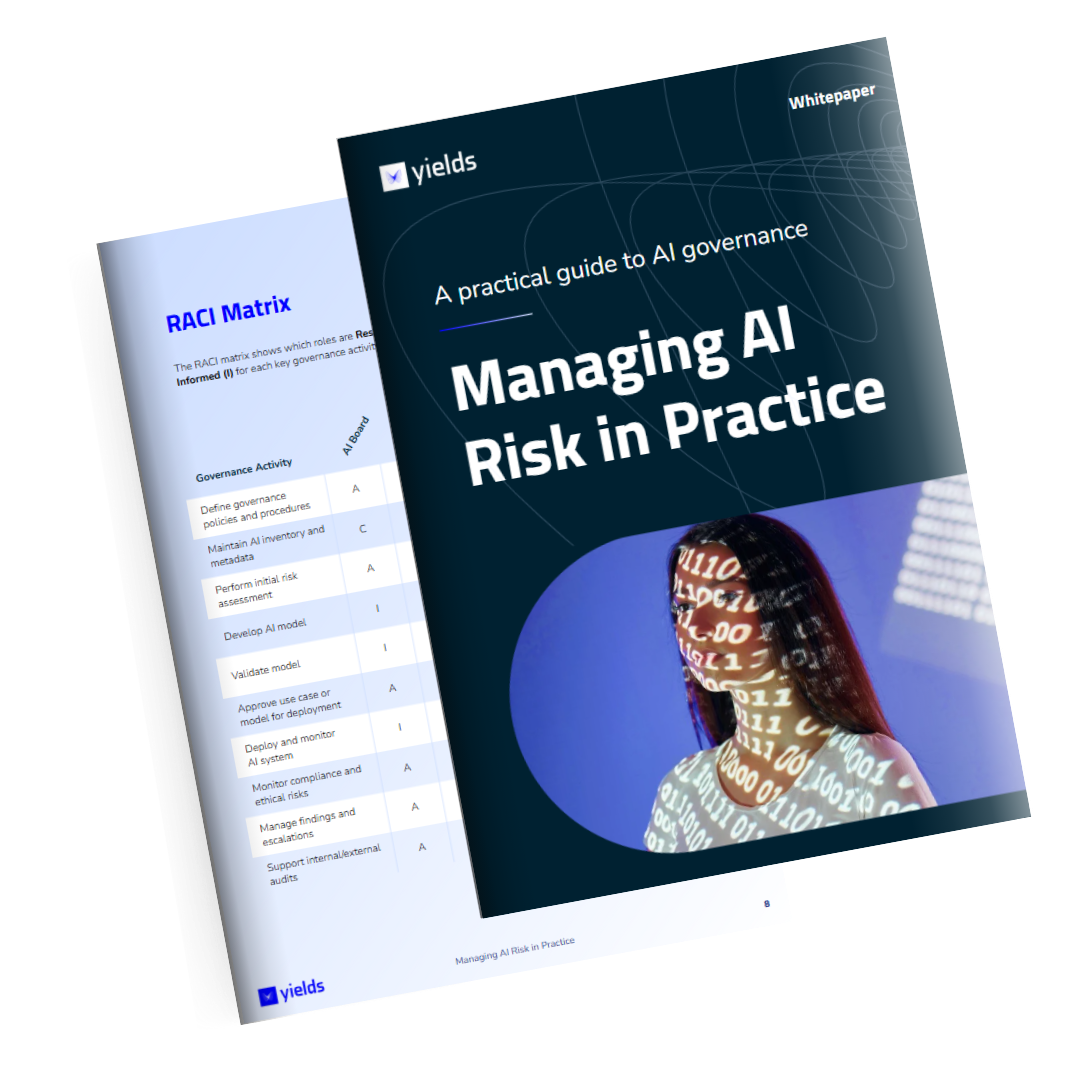
eBook
Ready to Take Control of AI Risk?
Download our practical guide to AI governance, built on a decade of real-world experience. Discover how to operationalize AI governance with clarity, structure, and confidence.
Author

Jos Gheerardyn has built the first FinTech platform that uses AI for real-time model testing and validation on an enterprise-wide scale. A zealous proponent of model risk governance & strategy, Jos is on a mission to empower quants, risk managers and model validators with smarter tools to turn model risk into a business driver. Prior to his current role, he has been active in quantitative finance both as a manager and as an analyst.